| Table of Contents |
| 18.1 Introduction |
| 18.2 Procedures |
| 18.3 Rooftop Exhaust Hazard Identification |
| 18.4 Supporting Documents |
18.1 Introduction #
The purpose of this Program is to prevent potential hazardous exhaust exposure to workers and users of hazardous exhaust systems while work is performed near, on or inside hazardous exhaust systems, including those from cryogenic and refrigerants.
EHS provides inspections of safety features and a cyclic certification of capture velocities as determined by an industrial hygiene risk assessment. EHS also tags faulty hoods as “out of service” (see Related Documents header) while awaiting maintenance by either the owner, or Facilities & Operations.
Reference Regulations: Ventilation Control (MIOSHA General Industry Part 520)
18.2 Procedures #
If a job involves working on a roof, or the interior of a hazardous exhaust system the supervisor shall utilize the Roof Safety Plans in EDMS Rooftop Safety Plans to Identify:
- Solid Red hazardous exhausts within 20’ of roof top work.
- Hazardous Exhaust Fume Hoods and fan numbers requiring shutdown
- If the building does not have a Roof Safety Plan, the supervisor shall contact AEC and EHS to assist with the determination.
Work requiring shut downs #
- Work within 20’ of a solid Red exhaust
- Work within the exhaust stream
- Work that will contact the interior of an exhaust system.
Shutdown Coordination #
- The Facilities & Operations Shutdown Coordination must be notified of any work requiring a shutdown. This is accomplished using the on-line Shutdown Request Form.
- The Building or Department Contact shall post a “Warning! Do Not Use This Hood” (see below) sign on all affected exhaust hoods, fume hoods, and ducted BSCs. Doors to the affected laboratories, corridors, and additional locations may also be posted to increase awareness. This information shall also be communicated by the Building or Department Contact to the affected users via e-mail, telephone, or in person.
- The Building or Departmental Contacts will be notified by Facilities & Operations and they will in turn, notify all users of the affected exhaust system prior to any shutdown of building systems.
- If researchers/users do not comply with the requirements of an exhaust system shutdown, the work shall not take place.
- Laboratory personnel or other users are required to adhere to the following steps to prepare for a shutdown. Failure to comply with this procedure may expose laboratory personnel and maintenance personnel to hazardous materials. Non-compliance with these requirements will result in the work not being completed as planned, causing delays in the ability to re-start research, and a report to the appropriate dean, director, or department head for possible disciplinary action.
- Do not use or conduct any experiments in a fume hood or exhaust system that connects to the shutdown system.
- Remove, cap, or cover all chemicals in affected hoods.
- Remove funnels and cap chemical containers in affected hoods.
- Turn off all equipment, such as hotplates and stirrers.
- If workers will need to enter or contact the interior surfaces, chemicals must be removed from the hood and the interior surfaces must be cleaned prior to workers entering. Immediately preceding the start of the scheduled work, the Building or Department Contact or designee shall inspect the impacted exhaust hoods to verify compliance. Any non-compliance shall be addressed by the Building or Department Contact and corrective action taken prior to the work proceeding. If the non-compliance cannot be corrected within a reasonable period of time, the work shall be rescheduled and the department may be billed for the wasted staff time.
Site Investigations for work on the interior of hazardous exhaust systems #
Specific site investigations for most potentially hazardous exhaust systems are not necessary. As necessary, the supervisor can arrange with EHS to perform a site investigation. The “EHS Hazardous Exhaust Investigation Checklist and Form” is a helpful guide for the site investigation. These are located in the Related Documents header of this program.
If an investigation is necessary, EHS will coordinate with other EHS programs to identify possible exposure concerns including:
- If radioactive materials are used in the affected fume hoods or exhaust system, EHS Radiation Safety Service (RSS) shall be contacted. If necessary, RSS will conduct a contamination survey of affected systems. After the survey has been conducted, RSS shall notify the supervisor with an email of the results and any additional precautions required.
- If Perchloric acid fume hoods are present, EHS Research Health and Safety shall determine if perchlorates have formed or the presence of perchlorates is suspected. EHS shall notify the project coordinator that a firm specializing in the cleaning and repairing of perchloric acid exhaust systems will have to be hired to abate the hazard before work can progress.
- If unusual circumstances or hazards were identified by the owner or noted by employees.
- For work that will contact the interior of the exhaust system it is recommended that the “EHS Hazardous Exhaust Investigation Checklist and Form” are completed. These are located in the Related Documents header of this program.
Personal Protective Equipment (PPE) #
Personal protective equipment shall be worn during work on all fume hoods and other potentially hazardous exhaust systems, to prevent skin contact with the interior surfaces of these systems.
- Safety Glasses or Goggles
- Gloves
- Disposable Suit/Coveralls
- Respiratory Protection – Typically not required unless work on a potentially hazardous exhaust system involves the potential for exposure to contaminated dust and/or exposure to residual chemicals. Contact EHS for information on the appropriate respirator cartridges.
- Radiation Monitoring Dosimeters (Badges) – Dosimeters shall be issued by RSS at the discretion of the Radiation Safety Officer (RSO) or RSS health physicist.
Biological Safety Cabinets #
A Biological Safety Cabinet (BSC) is designed to contain biological hazards. Repairs should only be made by certified U-M EHS Biological Safety technicians.
18.3 Rooftop Exhaust Hazard Identification #
Exhaust system Labeling #
Region Maintenance shall identify exhaust systems according to the Roof Safety Plans and this program and post warning signage on access doors to the roofs.
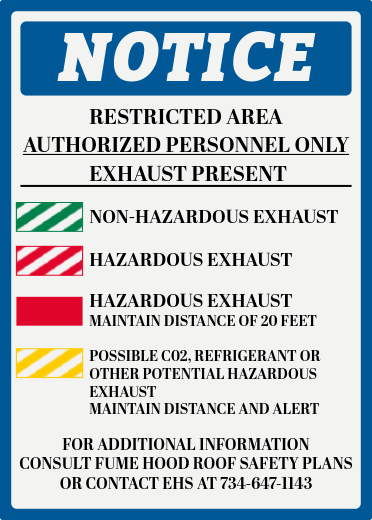
All exhaust systems on a roof with potentially hazardous exhaust will be identified with one of four designations: green/white stripes, red/white stripes, solid red, or yellow with white stripes. A legend will be posted on all roof access points based on the descriptions below:
- Green and White Diagonal Stripes: Safe to approach and safe to work on the system at any time. No hazardous constituents exhausted. An example would be general building exhaust.
- Yellow and White Diagonal Stripes: Generally safe to approach and work around with caution. Avoid working directly in front of the exhaust point. These exhaust systems have the potential to unexpectedly emit helium, carbon dioxide, or refrigerant gas and create a low-temperature and/or an oxygen deficient environment around the stack. Actual work on the system will require a coordinated shut down. Employees must maintain situational awareness and leave the area if gas clouds or atypical exhaust patterns emanate from the stack or exhaust grill.
- Red and White Diagonal Stripes: Potentially hazardous exhaust system meeting minimum safety and engineering requirements. Exhaust systems meeting these requirements have sufficient exhaust stack height and velocity to eject potential hazards outside the building envelope. These systems are safe to approach and work around. Actual work on the system or over the exhaust stream will require a shutdown and compliance with this EHS program.
Typically, direct drive high plume, induced flow exhaust fan systems will be identified as Red and White Diagonal Stripes. These systems meet or exceed the minimum effluent flow standards established by UPE and EHS. The minimum standard for any exhaust labeled Red/White stripes is that the physical stack height is not less than 10 feet high, the exit velocity from the stack is not less than 3,000 feet per minute (fpm), and the system is equipped with a bleed-in damper to supply make-up air. The bleed-in damper will ensure a constant stack exit velocity regardless of hood sash heights, filter loading, or anything else that would normally reduce flow from a stack. - Solid Red: Potentially hazardous exhaust system that must be shutdown in order to approach within 20 feet of the exhaust stack. By default, all chemical fume hoods that are NOT part of a direct drive high plume, induced flow exhaust fan system will be designated as Solid Red regardless of what hazardous materials are in use.
18.4 Rooftop Radiofrequency Hazard Identification #
Radio Frequency Transmission Antennae Shutdown Procedures #
For any roof work, the supervisor shall consult the Roof Safety Plan to determine if the building has a RF (typically a cellular node) hazard potential. If the building has a cellular node, supervisors will advise workers to remain six feet away from the face of an antenna. Barricades may also be present to indicate a restricted access zone.
If barricades are not present, signs will be posted in the area to notify workers of the RF hazard. If workers cannot remain six feet from the face of antennas or if they must work within the barricaded area, a shutdown must be scheduled. Lockout Tagout procedures must be followed for all staff members working within a restricted access zone. If work takes place on a shared ITS and U-M-Utility pole there may be an RF hazard, and there is a hazard potential if a blue “Notice”, yellow “Caution”, or orange “Warning” sign is present.
Facilities & Operations Shutdown Coordination must be notified of any work requiring a shutdown. This is accomplished by contacting the Facilities Service Center (647-2059 or [email protected]). After completion of work, follow the Lockout Tagout Program procedures for removal of locks/tags.
FCC Radio Frequency Hazard Sign Examples #
| Guidelines | Notice | Caution | Warning |
| The sign will inform anyone of the basic precautions to follow when entering an area with transmitting radiofrequency equipment. | This sign indicates that RD emissions may exceed the FCC General Population MPE limit. | This sign indicated that RF emissions may exceed the FCC Occupational MPE limit. | This sign indicated that RF emissions may exceed at least 10x the FCC Occupational MPE limit. |