10.1 Introduction #
Services performed by University employees that involve work on or near permanent or temporary electrical parts and wiring, fixtures or equipment, all work involved with constructing, installing, removing, renovating, or modifying electrical parts and wiring, fixtures or equipment, and all work involved with generating, transmitting or distributing utility electrical power services shall follow the requirements of this program.
All hazards involved with electrical work must be evaluated and adequately controlled following the basic safety practices used for all hazards (i.e., engineering controls, administrative controls, and PPE). This includes performing work on or near permanent or temporary electrical parts and wiring, fixtures or equipment, all work involved with constructing, installing, removing, renovating, or modifying electrical parts and wiring, fixtures or equipment, and all work involved with generating, transmitting or distributing utility electrical power services.
The Utilities Department is responsible for providing electricity to university buildings. A portion of the electricity used on campus is generated at the Central Power Plant. Maintenance Services is responsible for the distribution of electricity providing power to outlets and to permanently wired fixtures and devices, such as light fixtures.
Reference Regulation:
Electric Power Generation, Transmission, and Distribution (MIOSHA GI Part 86)
Standard for Electrical Safety in the Workplace (NFPA 70E)
10.2 General Requirements #
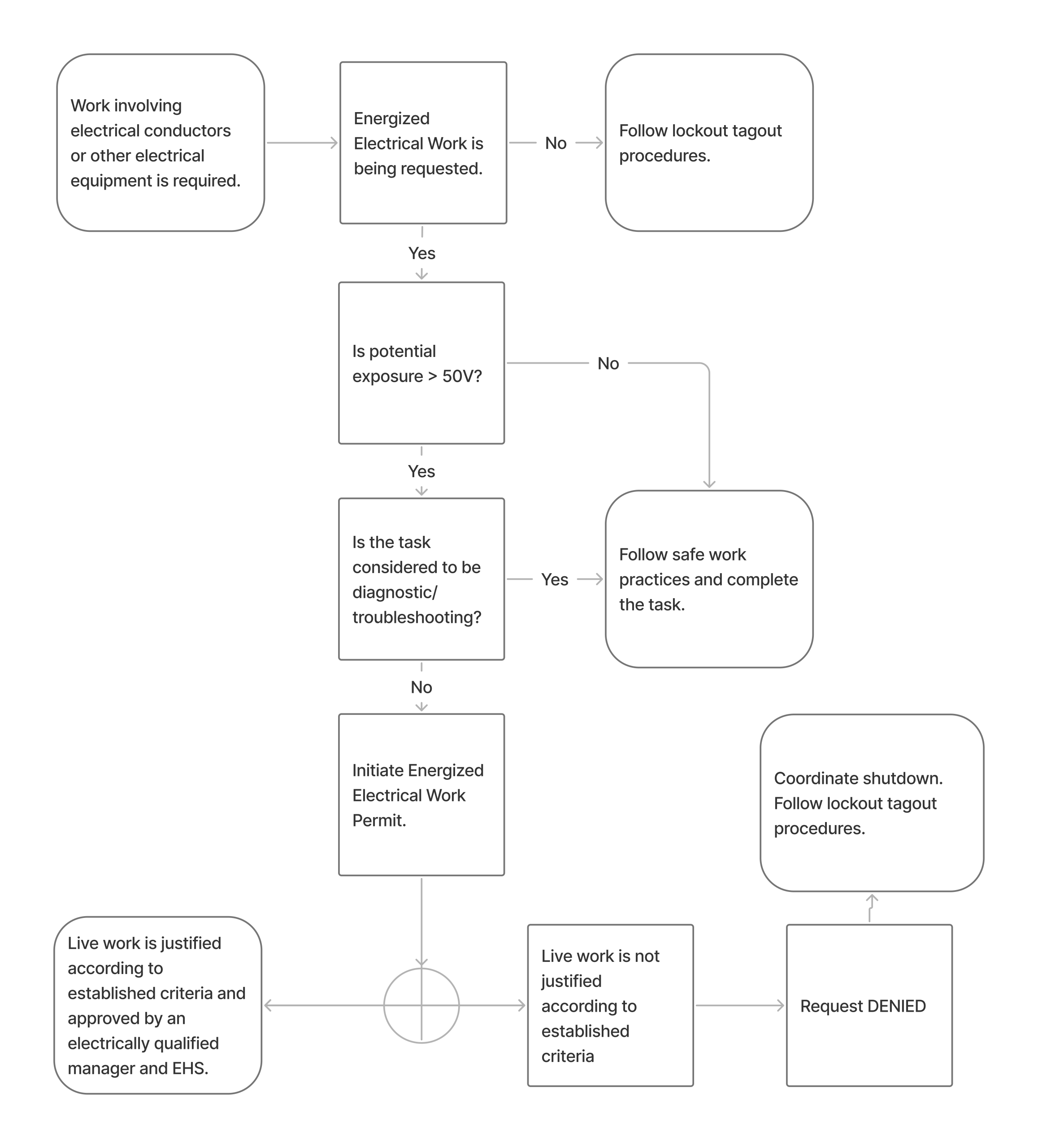
Working on or near exposed energized electrical parts or equipment with a nominal voltage of more than 50 volts is prohibited unless approved through the energized electrical work permit process. Complete the Energized Electrical Work Permit located in the Related Documents header, when required. Lockout/tagout procedures will be followed in order to assure equipment is adequately de-energized and in an electrically safe work condition for work to be done. See Section 10.11 for details on energized electrical work.
Electrically Qualified Person (EQP) #
For certain conditions as identified in this program, only an electrically qualified person (EQP) may complete the work. Refer to definition and department specific policies on electrically qualified persons.
Non-Qualified Electrical Worker #
Workers considered to be non-qualified for electrical work are prohibited from working on or near energized exposed electrical parts with a nominal voltage of more than 50 volts, being inside the limited approach boundary to exposed energized electrical parts without being accompanied by an EQP, being inside the restricted approach boundary to exposed energized electrical parts, or being inside the arc-flash protection boundary to exposed energized electrical parts. Lockout/tagout procedures will be followed in order to assure equipment is adequately de-energized and in an electrically safe work condition before conducting the work to be done.
Where arc-flash analyses are conducted, they will follow the analysis methods recommended by NFPA 70E or IEEE 1584. Arc-flash analyses will be conducted by properly trained and qualified personnel. Arc-flash analysis information will be included on equipment safety labeling in accordance with the labeling guidance of this program.
10.3 Electrical Power Generation, Transmission and Distribution Work #
Work practices used during the operation and maintenance of electrical power generation, transmission, and distribution facilities are subject to additional requirements for hazardous energy control, working near energized parts, installation of protective grounding, underground and overhead installations, clearance of overhead lines for tree trimming, substation and generating plants, and other conditions and equipment unique to the generation, transmission, and distribution of electric energy. Supervisors must observe and inspect EQP doing this type of electrical work at least annually, to ensure they are following safe work practices. See section 10.11 for energized electrical work requirements.
First Aid and Cardiopulmonary Resuscitation (CPR) #
When employees are performing work on, or associate with, exposed lines or equipment energized at 50 volts or more as part of electrical power generation, transmission, and distribution work, persons with first aid training and CPR shall be available.
- For field work, at least two workers trained in CPR and first aid will be readily available.
- For fixed location work, a sufficient number of personnel trained in CPR and first aid will be readily available.
- First aid kits and supplies will be readily available for use and kept adequately stocked according to ANSI First Aid Standard Z308.
Live-line Tools (hot sticks) #
Will be:
- Designed and constructed in conformance with industry standards.
- Inspected before each use and removed from service when defective.
- Removed from service and tested at least once every two years.
Protective Grounding #
- All temporary electrical parts, to include temporary lighting, will be adequately grounded.
- Whenever practical, lines will be grounded with No. 2/O American Wire Gauge (AWG) sized copper wire or greater. Lines will be tested for zero nominal voltage before grounds are installed.
- The ground connection will be made first and the connection to the line will be made using a live-line tool. Grounds will be removed at the line first, using a live-line tool. Grounds may be removed temporarily to conduct tests.
- Work may be done without protective grounds if the lines and equipment are de-energized, there is no possibility of contact with another power source, and there is no induced voltage hazard.
Overhead Lines #
- Equipment will be kept well away from overhead lines. If equipment is required in the area of overhead lines, it will be kept at the minimum safe approach distance of 10 feet. A worker other than the equipment operator will watch during equipment movement to ensure the safe approach distance is maintained.
- Tree trimmers, not specifically trained to work around power lines, must remain at least 10 feet away from power lines.
Capacitors #
- Capacitors will be disconnected, and then after waiting five minutes, short circuited and grounded before being worked on.
Current Transformer Secondaries #
- The secondary of a current transformer may not be opened while the transformer is energized.
- If the primary of the current transformer cannot be de-energized before work is done on an instrument, a relay or other section of a current transformer secondary circuit, the circuit will be bridged so that the current transformer secondary will not be opened.
Series Street Lighting #
- Series street lighting will be worked by following the line clearance procedures outlined above. A series loop may only be opened after the street lighting transformer has been de-energized and isolated from the source of supply or after the loop is bridged to avoid an open circuit condition.
- The repetitive manual reclosing of circuit breakers or reenergizing circuits through replaced fuses is prohibited. See Circuit Breaker Safety Policy located in the Related Documents header.
10.4 Construction Site Electrical Work #
All temporary electrical parts, to include temporary lighting, will be adequately grounded.
All extension cords, cord sets, receptacles that are not part of the permanent wiring, including temporary lighting, and equipment connected by cord and plug, will be connected to electrical power through a GFCI.
Two Electrically Qualified Persons will be present when working on or near exposed energized electrical parts with a nominal voltage of 440 volts or more.
Temporary parts and wiring, not considered part of a continuing construction project, will be replaced with permanent wiring within 30 days of initial installation.
10.5 Electrical Parts, Wiring, and Installations #
All electrical parts and wiring, permanent or temporary, will be enclosed or protected and conform to the applicable electrical and building code requirements.
All new installations, non-minor repair work, and replacements of multiple units that fall within the National Electric Code (NEC), or specific electrical installations regulated by state law, will be inspected by the U-M electrical inspectors for compliance with these standards prior to use. All repair and replacement installations that occur due to a major incident, system fault or failure will be inspected, if practical, before putting the existing systems back into operation, or as soon as possible (e.g., the next regular business day) after being put back into operation.
Appropriate warning labels will be included on all new electrical installations, as well as old installations as hazard information becomes available. Hazard labels will include: nominal system voltage; arc-flash boundary distance; and at least one of the following: incident energy at working distance; minimum arc-rated clothing; PPE level; or hazard/risk category.
10.6 Training #
All workers that use electricity, electrical equipment or devices as part of their normal job duties (i.e., non-qualified workers), will be trained in the general hazards and safeguards for using electricity, electrical equipment and devices. These training records will be maintained by the departments.
All workers required to do electrical work (i.e., electrically qualified persons), or work on or near exposed electrical parts, must be qualified and trained in the specific hazards involved with the work tasks they are qualified to perform, and the safety related work practices necessary for them to safely do their job. They must specifically be trained in the following:
- The skills and techniques necessary to distinguish exposed energized electrical parts from other parts.
- The skills and techniques necessary to determine the nominal voltage of exposed energized electrical parts.
- The safety procedures, safe clearance distances, and minimum approach distances required for working near energized exposed electrical parts.
- The proper use of special precautionary techniques
- The proper use of personal protective equipment, insulating and shielding materials, insulated tools for working on or near exposed energized electrical parts
- Workers required to use electrical PPE for protection from electric shock or arc-flash will receive training on this PPE in conformance with the NFPA 70E
Workers conducting electric power generation, transmission or distribution work must be trained in all aspects of an electrically qualified person. Additionally, they must be trained in first aid, CPR, and the requirements listed in MIOSHA General Industry Safety Standard Part 86 (Electric Power Generation, Transmission and Distribution).
Tree Trimmers required to work in close proximity (i.e., less than 10 feet) to electrical transmission lines will be trained in the necessary safety procedures, minimum safe approach distances, and the pertinent sections of the MIOSHA General Industry Safety Standards and the requirements listed in MIOSHA General Industry Safety Standard Part 86 before being allowed to work near power lines.
Qualified workers will be retrained:
- Whenever there is a change in work practice, procedure, or technology.
- Whenever a worker is unable to adequately demonstrate knowledge of the required safety precautions.
- As a best practice it is recommended retraining take place every three years, to ensure that safety practices and procedures are adequately maintained and followed.
Workers will be trained in emergency response procedures, including electrical contact release.
10.7 Personal Protective Equipment #
Workers working on or near exposed energized electrical parts or equipment, including troubleshooting, will use appropriate personal protective equipment (PPE) and tools to protect them from the potential electric shock, arc-flash and fire hazards of the equipment being worked on or near. Examples of PPE and tools include but, not limited to the following:
- Hard Hat with Flash Protection Face Shield
- Insulated Gloves
- Arc-Rated Clothing
- 100% Cotton Clothing
- Voltage Meter
- Wooden/ Fiberglass Ladder
- Proximity Tester
- Rubber Matting
Employees will follow the NFPA 70e 2024 tables,130.7 (C) (15) (a) Arc Flash for Alternating current (ac) and 130.7 (C) (15) (b) Arc Flash for Direct Current (dc) for selecting their personal protective equipment during specific tasks.
All PPE used for protection from electrical energy, to include gloves, matting, blankets, covers, hoses and sleeves, must be manufactured, regularly tested and routinely inspected in accordance with the MIOSHA safety standards and the applicable American Society for Testing and Materials (ASTM) guidelines.
Workers working on or near exposed energized electrical parts or equipment will wear clothing, including undergarments, that will NOT increase the hazards of exposure to flame or electric arc, such as materials made of non-synthetic natural fibers, or fabric specifically designed for use around electrical parts. Workers must remove conductive articles, such as rings, watches, chains, etc., prior to entering the restricted boundary.
Qualified employees shall wear rubber insulating gloves with leather protectors and rubber insulating sleeves where there is danger of hand arm injury from electric shock due to contact with energized electrical conductors or circuit parts.
- Rubber insulating gloves shall be rated for the voltage for which the gloves will be exposed.
- Electrical gloves shall be inspected daily prior to use by the employee using the gloves.
- Electrical gloves shall be 3rd party tested every year if not in use. If in use, the gloves shall be 3rd party tested every 6 months.
- Where insulating rubber gloves are used for shock protection, leather protectors shall be worn over the rubber gloves.
Clothing shall cover the potentially exposed areas as completely as possible. Shirts and coverall sleeves shall be fastened at the wrists, shirts shall be tucked into pants, and shirts, coveralls, and jackets shall be closed at the neck.
10.8 Personal Protective Equipment Inspection and Care #
Arc-rated apparel shall be inspected prior to each use. Contaminated or damaged work clothing or arc suits shall not be used. Protective items contaminated with grease, oil, or flammable liquids shall not be worn.
The garment manufacturer’s instructions for care and maintenance of arc-rated apparel shall be followed. Arc-rated apparel shall be stored in a manner that prevents damage. Arc-rated apparel shall be cleaned following the manufacturer’s instructions. If arc-rated clothing is repaired, the same arc-rated materials that make up the clothing are to be used for the repair.
10.9 Approach Boundaries #
Approach boundaries are linear distances measured from exposed energized electrical conductors which are not safe to pass. Different boundaries are set for different electrical energy sources (e.g., AC voltage, DC voltage, pulsed voltage, etc.) and different worker qualification (e.g., qualified workers, unqualified workers). These approach boundaries are also used to determine PPE requirements.
Adequate approach boundaries should be observed, as well as PPE requirements for conducting diagnostics, and these systems should be put into an electrically safe work condition prior to being worked on. LOTO or Energized Electrical Work Permit (EEWP) is required for service/maintenance work inside the shock protection boundary.
10.10 Energized Electrical Work Permit #
Live parts equal to or greater than 50 volts to which an employee may be exposed shall be deenergized before the employee works on or near them, unless the employer can demonstrate that deenergizing introduces additional or increased hazards or is infeasible due to equipment design or operational limitations. Examples of increased or additional hazards include interruption of life support equipment, deactivation of emergency alarm systems, shutdown of hazardous location ventilation equipment, or removal of illumination for an area.
For equipment where deenergizing may introduce additional hazards or is infeasible, an energized electrical work permit (EEWP), located in the Related Documents header of this program, identifying the reason the circuit/equipment cannot be deenergized and locked out must be submitted to EHS for justification and approval. Arc-flash analysis for approved EEWP will be conducted by AEC and Utilities. All energized electrical work permits shall be sent to EHS to be kept on file.
A job briefing will be conducted before each energized electrical job, including troubleshooting, begins and at least once daily when electrical work is planned to occur. The briefing will cover the:
- Hazards of the job
- Work procedures to be followed
- Special precautions required
- Energy source controls, and
- PPE (Complying with the NFPA 70E 2024 Standard)
Energized Electrical Work Practices #
- Two EQP will be present when working on or near electrical parts that carry more than 600 volts.
- One EQP may perform routine switching if conditions allow work to be done safely on equipment designed for the purpose and in normal operating condition.
- One EQP may use live-line tools if they are out of reach or otherwise not exposed to contact with live energized parts.
- One EQP may make emergency repairs to the extent necessary to protect the public.
- Workers will remain at a safe distance from energized parts unless the workers or parts are adequately insulated.
- Workers will work in positions that help prevent inadvertent contact with live energized parts.
- When making connections to energized parts, the connection to the energized part will be made last. When disconnecting from energized parts, disconnect at the energized source first.
- Removing or installing fuses will be done using tools and protective equipment rated for the shock and arc-flash hazard of the parts. Workers installing expulsion type fuses will wear eye, face and head protection.