- Biological Safety Cabinet
- Chemical Fume Hood
- Vertical Laminar Flow Polypropylene Hood—"Hybrid Hood"
- Local Exhaust Ventilation
- 37.2 Unsafe Engineering Control Equipment
- Definitions
- Procedure
- 37.3 Biological Safety Cabinet Service Criteria
- Planned Antiquation
- Categories of Service
- Service Charges
- 37.4 Biological Safety Cabinet Maintenance
- Installation Criteria to Ensure BSC Service from EHS
- Regulatory Issues
- Services
- 37.5 Biological Safety Cabinet Warranty Work
- Stipulations
- Warranty Work Fee Schedule
- 37.6 Biological Safety Cabinet Decommissioning for Sale, Repair, Transfer, or Scrap
- Procedure
- Disabling Process
- Repair, Moving, Transfer, or Sale
- Contacts and Form Links
- Compliance
- 37.7 Purchasing a Biological Safety Cabinet
- Process to Purchasing and Installing a BSC
- Approved Manufacturers
- Caution for Purchases through Third-Party Vendors
37.2 Unsafe Engineering Control Equipment
37.3 Biological Safety Cabinet Service Criteria
37.4 Biological Safety Cabinet Maintenance
37.5 Biological Safety Cabinet Warranty Work
37.6 Biological Safety Cabinet Decommissioning for Sale, Repair, Transfer, or Scrap
37.7 Purchasing a Biological Safety Cabinet
| Related Documents |
| Do Not Use – Out Of Service Placement of BSC with Dimensions Laboratory Equipment Owner Decontamination form Property Disposition Declaration of Surplus (DOS) form |
Environment, Health & Safety (EHS) ventilation engineering controls certification program is designed to ensure that the following critical systems are working properly and meet current health and safety standards.
Services to units outside of the General Fund structure are billed for provided services
Biological Safety Cabinet #
A biological safety cabinet (BSC) is a Class II unit providing personnel, product and environmental protection. The majority of applications involve containment of biological hazards while providing a sterile field for vulnerable experimental materials.
Provided Services #
EHS provides annual certification with aerosol challenge filter testing, filter repair/replacement, balancing, maintenance (see section 37.4: BSC Maintenance) and decontamination as necessary. Additional certifications beyond the annual will be billed to the BSC owner.
Maintenance, parts, and filters will be rebilled on BSCs over 10 years old (see Section 37.3: BSC Service Criteria).
New units still under warranty (typically 4 years) will be repaired by the manufacturer’s representative (See Section 37.5: BSC Warranty Work). EHS technicians are approved to provide warranty work on most BSC brands with manufacturer’s authorization.
Reporting #
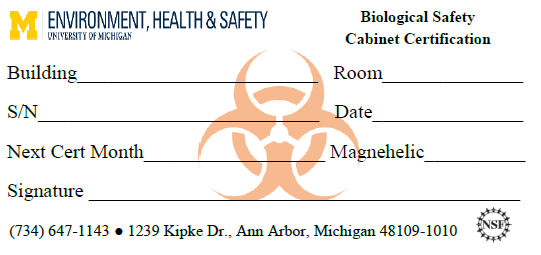
A BSC certification sticker
(actual size 3.5″ x 2 “) is placed on the unit indicating the date of the certification.
If requested, a report can be printed from the database for BSCs requiring detailed documentation for audit. An email report detailing equipment problems, filter change requirements, and maintenance repair is sent to the listed owner of the device.
Chemical Fume Hood #
A chemical fume hood (FH) only provides personal protection. It continuously exhausts contaminated air from the work area.
Provided Services #
EHS provides annual certification of the airflow velocities at the face of the FH and inspects safety features including, but limited to, the sash stop, the mobility of the sash, the airflow monitor, and the interior of the FH workspace. Facilities & Operations Maintenance department provides mechanical maintenance. EHS tags faulty hoods as “out of service.”
Reporting #
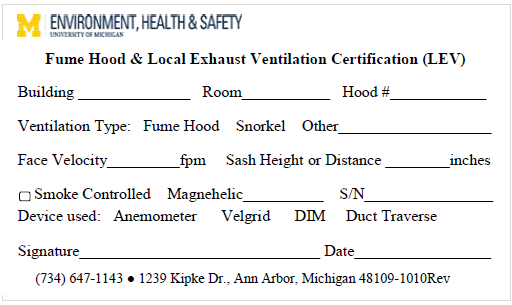
A Fume Hood certification sticker (actual size 3.5″ x 2 “) is placed on the unit indicating the date of the certification.
Failing FHs are posted out of service. An email report is sent to the Facilities Service Center to start work orders on these FHs. For archive, an Access report is generated and saved semiannually to S:\Biosafety\1.5 Fume hood Certification Reports. EHS tags faulty hoods as “out of service.”
Vertical Laminar Flow Polypropylene Hood—”Hybrid Hood” #
Vertical Laminar Flow Polypropylene (VLFP) Hood is a metal-free exhausted fume hood that provides personnel protection with a purified air curtain for product protection.
Provided Services #
EHS provides annual certification of inflow and down-flow velocities with balancing as necessary. The owner
must provide EHS with a manual that details certification specifications and methods. The owner is responsible for all maintenance and filter replacement costs.
Reporting #
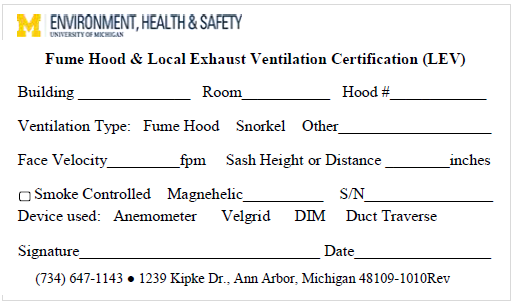
A Fume Hood certification sticker (actual size 3.5″ x 2 “) is placed on the unit indicating the date of the certification.
Failing VLFPs are posted out of service. An email report is sent to the Facilities Service Center to start work orders on these VLFPs. An email report detailing VLFP E equipment problems, filter change requirements, and maintenance repair not performed by Facilities & Operations is sent to the equipment owner. For archive, an Access report is generated and saved semiannually to S:\Biosafety\1.5 Fume hood Certification Reports.
Local Exhaust Ventilation #
Local exhaust ventilation (LEV) equipment is a variety of configurations for local exhaust or capture of point source emissions, providing personnel protection and/or smoke, odor, dust or heat control. LEVs include snorkels, canopies, paint booths, gas cabinets, slot hoods, laser cutters, etc.
Provided Services #
EHS provides inspections of safety features and a cyclic certification of capture velocities as determined by an industrial hygiene risk assessment. Facilities & Operations department or the owner provides maintenance for the LEV. EHS tags faulty hoods as “out of service.”
Reporting #
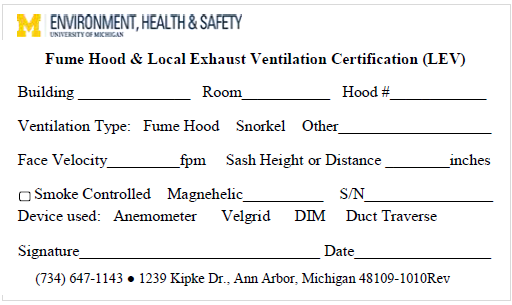
An LEV Hood certification sticker (actual size 3.5″ x 2 “) is placed on the unit indicating the date of the certification.
An email report is sent to the Facilities Service Center to start work orders on failing LEV equipment. An email report detailing equipment problems, filter change requirements, and maintenance repair not performed by Facilities & Operations is sent to the equipment owner. For archive, an Access report is generated and saved semiannually to S:\Biosafety\1.9 LEV Reports.
Laminar Flow Device #
A laminar flow device (LFD) is a HEPA-filtered cabinet designed specifically for product protection and quality control (clean bench). LFDs do not provide personnel or environmental protection. LFDs are used for “sterile field” work, either clinical preparations or research.
Provided Services #
All services provided for LFDs will be billed. LFDs are designed for quality control, not occupational health and safety. At the request of the owner, EHS will provide annual certification of face velocity, aerosol challenge filter testing, and inspection of full functionality to ensure sterile field for QA/QC reporting. Maintenance and filter replacement services are also available, and the owner of the LFD will be billed for time and materials.
Reporting #
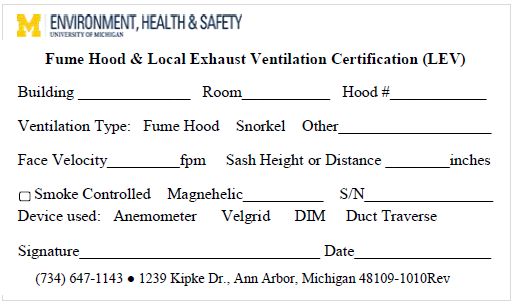
An LEV Hood certification sticker (actual size 3.5″ x 2 “) is placed on the unit indicating the date of the certification.
If requested, a one page report can be printed from the database for clinical units needing detailed documentation. An Access report is generated and saved semiannually to S:\Biosafety\1.6 BSC Reports. An email report detailing equipment problems, filter change requirements, and maintenance repair not performed by EHS is sent to the equipment owner.
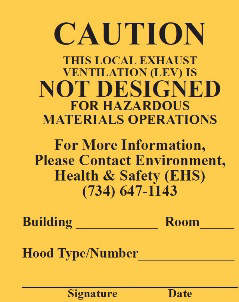
As LFDs are relegated specifically to nonhazardous use, they will receive a notification sticker indicating “Caution – this hood is Not Designed for hazardous materials operations” (actual size2″ x 3.5″ to exclude use of biohazardous or chemically hazardous materials.
Service Charges #
- BSC and LFD service charges are detailed in the BSC Service Criteria document.
- Certification service for General Fund customers is free of charge except for LFDs.
- Certification service charges for non-General Fund equipment including FH, VLFP, LEV, and LFD will be billed per standard rates in the BSC Service criteria document or at an hourly rate of $82.00/ hour.
37.2 Unsafe Engineering Control Equipment #
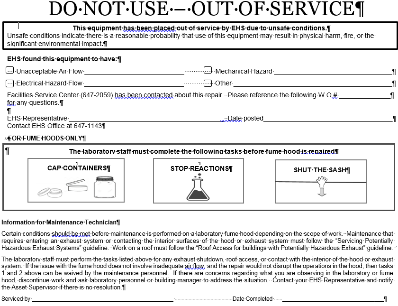
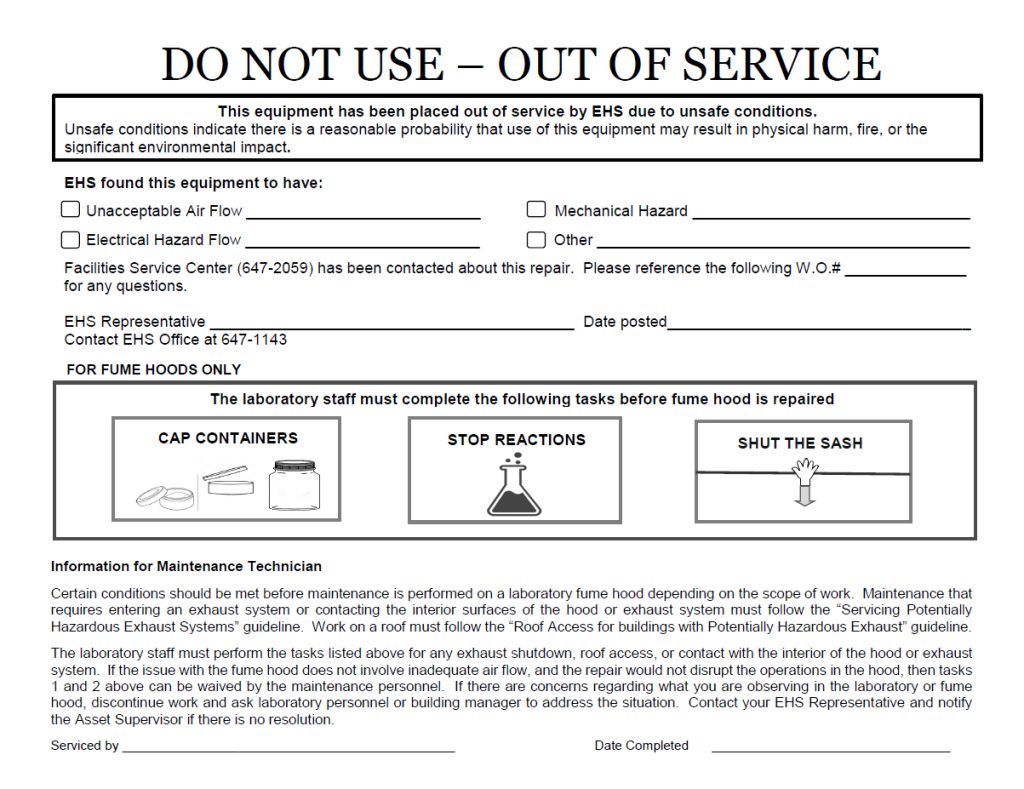
EHS Technicians occasionally identify unsafe conditions related to the engineering control equipment they certify. In these circumstances, the technician has the authority to remove the equipment from service. This document describes the procedure.
Definitions #
Engineering Control Equipment
- Refers to devices certified by EHS Technicians: laboratory fume hoods, biological safety cabinets (BSC), laminar flow hoods, snorkels, booths, gas cabinets and other local exhaust ventilation equipment (LEV).
Unsafe Conditions
- There is a reasonable probability that use of the equipment will result in serious physical harm, fire, or significant environmental impact if the equipment continues to be used.
Procedure #
The technician responsible for the certification of the equipment will determine if an unsafe condition exists. The technician will confer with their supervisor, the responsible EHS Representative, or Program Manager if unsure whether a condition is classifiable as unsafe.
After it has been determined there is an unsafe condition, the technician must take the following actions.
- Do not certify the equipment and remove or deface old certification stickers.
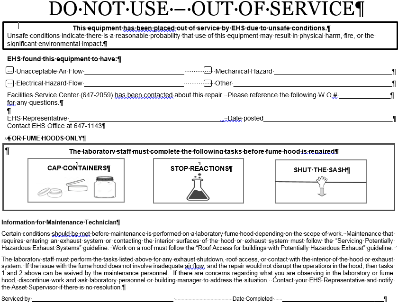
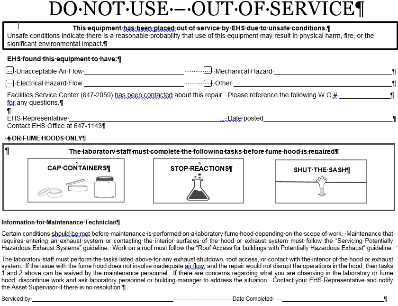
- Post the equipment out of service using the “Out of Service” form below.
- Notify the on-site owner/operator of the equipment that this equipment cannot be used. Notification would typically be made to the lab manager, supervisor, or Principal Investigator (PI). If no one is present to notify, go to the next step of this procedure.
- Upon returning to the office the technician will send an email notification to the PI, the EHS Representative for that area, and the appropriate contact responsible for maintenance of the equipment (if applicable). Typically fume hoods and LEV equipment notification is made to Facilities & Operations through a work order. For BSCs, laminar flow hoods, and other equipment owned by the laboratory, the lab is responsible for repair either through coordination with EHS or an outside vendor.
The responsible EHS Representative will work with the lab manager, PI, or supervisor to find solutions to their engineering control needs and ensure safe practices are followed until the situation is resolved. The Biosafety Manager and the EHS Director understands that these types of shut downs of fume hoods, LEV, and BSCs occur frequently and supports these procedures.
This document does not require notification of EHS management for typical cases with some caveats below.
- If there is a question about the validity of taking a piece of equipment out of service the Technicians will notify the EHS Technical Services & Solutions (TSS) manager as well as the Biosafety Manager for BSCs.
- Contacts with upper level management must be referred to the TSS Manager.
- Issues that may involve Deans, Directors, or Department Heads must immediately be brought to the attention of the TSS Manager and EHS Director.
If possible, actions will be taken to remediate potentially unsafe conditions on site to avoid shutting down operations or removing equipment from service.
Commissioning Equipment
Upon receiving notification that the equipment has been repaired, the Technician will attempt to certify the unit. If certification is achieved, the equipment will be put back in service and the posting will be removed.
37.3 Biological Safety Cabinet Service Criteria #
This document describes the categories of BSC service provided to University of Michigan departments and details service charges and the conditions under which the fees would be applied.
It also explains planned antiquation of BSCs recognizing that over time, all mechanical and electronic equipment becomes antiquated. Sometimes this is by manufacturer design or by other factors including technological advances or age of the components.
Planned Antiquation #
Planned antiquation is the recognition that BSCs are typically supported by the manufacturers for only 10 years and that plans must be made to replace this critical research equipment. The manifestations of this condition include increased maintenance costs due to expensive replacement parts, unavailable replacement parts, absence of information or technical support necessary for service, and concerns with structural safety or serviceability due to age or an unreliable/outmoded design. Any BSC manufactured over 10 years ago is potentially unserviceable.
EHS will maintain most BSCs for up to 10 years in the normal service category below. If you have concerns about the service category of your BSC or availability of replacement parts, please contact your EHS Technician. You will need to have the unit’s model and serial number.
Categories of Service #
Normal, General Fund Customers #
Regular annual certification and maintenance, including HEPA filter, motor/blower, speed controller changes, decontamination, and damper adjustments will be performed at no charge for BSCs under 10 years of age, with readily available parts. Departments will be charged for additional certifications beyond the annual certification as well as for decontaminations due to equipment moves or by request.
Normal, Non-General Fund Customers #
Regular annual certification and maintenance, including HEPA filter, motor/blower, speed controller changes, decontamination, and damper adjustments will be performed according to the Service Charges section in this document on modern BSCs with readily available parts. The cost of replacement parts and filters will be billed including shipping.
Customers will be required to provide EHS with a short code to recharge for the services rendered in this category.
Recharge #
When a BSC is no longer manufactured the replacement parts become more expensive and more difficult to obtain. Technical support and information necessary to service the unit is also less reliable. In these instances, EHS reserves the right to recharge General Fund customers in order to recoup excessive costs for maintaining antiquated equipment.
- BSCs over 10 years old are automatically placed in this category.
- Used BSCs transferred to U-M or purchased by General Fund units are expected to be in good operating condition upon arrival. Those that are not will be placed in the recharge category until they can pass certification.
- Customers will be required to provide EHS with a short code to recharge for the services rendered in this category.
No Service #
As with all scientific equipment, BSCs will become obsolete. Indications of obsolete BSCs include; age, obsolete design, compromised structural integrity, inadequate identifying information including missing serial or model number, defunct manufacturer, unavailable or prohibitively expensive replacement parts or extended service time.
EHS will not service BSCs which are not listed by NSF International unless the manufacturer verifies that the BSC is based on listed designs and there are no functional differences. BSCs that require extraordinary measures to maintain certification will not be serviced. Also, EHS cannot certify as safe or effective any unit that has been modified, retrofitted, reengineered, or used in a manner that could affect containment or airflow that was not approved by the manufacturer and NSF International.
Warranty #
BSCs from approved manufacturers typically come with a 4 year warranty. Customers will be asked to contact their sales representative to coordinate repair and certification of BSCs still under warranty. Contact EHS for assistance in contacting or coordinating with the manufacturer.
EHS Technicians may be contacted by the manufacturer to perform warranty work. In these cases the manufacturer will be billed per EHS’s Section 37.5 Warranty Work.
Risk Management (Insurance) #
BSCs damaged through sudden or accidental events fall into this category. The events must be reported to the U-M Insurance and Claims Administration and a claim made. Insurance and Claims Administration will determine if the claim is covered.
EHS will repair BSCs in this category per the standard service charges in section 4.0 plus additional charges for all parts, filters, and shipping costs.
Customers will be required to provide EHS with a short code to recharge for the services rendered in this category.
Service Charges #
Service charges for non-general fund customers and unsupported Biological Safety Cabinets and Laminar Flow Hoods are as follows:
NOTE: Additional charges for replacement filters and parts will be applied.
| Environment, Health & Safety Services $82.00 / hour |
| Biosafety Cabinets (BSC) Decontamination Fee $400.00 / fee |
| Laminar Flow Cabinet Certification Fee $100.00 / fee |
| Biosafety Cabinets Certification Fee $150.00 / fee |
| Motor Change Fee $200.00 / fee |
| Filter Change Fee $200.00 / fee |
At the customer’s request and with the approval of the Director of EHS, work can be scheduled for non-business hours and weekends. Set charges and/or hourly fees will be 50% higher for work during these hours.
37.4 Biological Safety Cabinet Maintenance #
EHS Technicians are trained in the use, certification, maintenance, and repair of Biological Safety Cabinets (BSC). They are “Qualified Persons” to perform diagnostic and maintenance procedures on these “Listed” devices.
EHS Technicians will not work on BSCs hardwired to the facility electrical distribution system nor work on any component of the facility electrical delivery system. EHS Technicians will only diagnose and maintain BSCs which have standard 115 volt single phase flexible cord power supply.
Installation Criteria to Ensure BSC Service from EHS #
The following installation criteria must be met to ensure the EHS Technicians will service a BSC.
• The BSC is installed in the correct location per the Placement of BSC with Dimensions document.
• The BSC installation adheres to applicable codes (i.e. electrical, mechanical, and plumbing)
• The BSC is installed following the manufacturer’s recommendations.
Regulatory Issues #
- The NEC, OSHA, and NFPA 70 do not include requirements for the wiring inside listed electrical equipment. However, they do require Listing by a qualified testing laboratory or nationally recognized testing lab.
- NFPA 70E Standard for Electrical Safety in the Workplace requires Qualified Persons to have training and experience to work on or near the specific exposed energized electrical conductors or circuit parts. EHS Technicians will only perform diagnostic procedures on energized equipment.
- Michigan Electrical Administrative Act 217 of 1956 (338.881-338.892) requires the licensing of electricians and provides an exception for the minor electrical repair work typically performed by EHS Technicians on BSCs.
- MIOSHA Part 85 Rule 408.18501 Lock Out Tag Out of hazardous energy sources typically does not apply because the BSC is unplugged during maintenance operations and the power cord is visible and under the direct control of the technician. When diagnostic functions are performed on an energized BSC the EHS Technician will use manufacturer provided diagnostic ports and voltage pins.
Amp meter readings are taken on insulated wires with a non-invasive meter. No maintenance work or repairs will be performed on energized BSCs.
Services #
- Diagnostic services addressing failure modes using approved manufacturer methods.
- Maintenance or replacement of manufacturer-approved components. This typically includes switches, speed controllers, motors, blowers, run capacitors, listed connectors, etc.
- EHS uses original manufacturer replacement parts for all BSC repairs. If manufacturer approved parts are not available, any substitute will require approval by a University engineer and EHS.
- EHS Technicians will not rewire or modify factory wiring or components.
37.5 Biological Safety Cabinet Warranty Work #
BSC manufacturers can request to have EHS Technicians perform warranty work on their BSCs at the University of Michigan. This will often greatly reduce the time a cabinet is out of service due to scheduling delays seen with outside certification and maintenance companies.
Stipulations #
- EHS can decline the work for any reason including scheduling, unfamiliarity with the manufacturer or model, and unfamiliarity with the maintenance to be performed.
- The BSC manufacturer must provide training to EHS Technicians periodically and when requested on new or modified products.
- All parts required for the repair will be provided to EHS free of charge under warranty, including shipping charges.
Warranty Work Fee Schedule #
Typical warranty work may require decontamination, repair and/or certification services. All required work will be billed according to the following rates:
- Photometer, smoke generator, flow hood, velometer, and standard tool usage are included in the hourly fee.
- Materials used for the service work will be billed at current prices.
- Mileage will not be billed to facilities on the main Ann Arbor campus. Offsite locations will be billed at the rate of $0.585 per mile to and from Ann Arbor, MI. Any airfare, hotel, and meal expenses will be billed at cost plus 10%.
37.6 Biological Safety Cabinet Decommissioning for Sale, Repair, Transfer, or Scrap #
This policy describes the Decommissioning of Biological Safety Cabinets (BSC) owned by the University of Michigan (U-M). The goal of the policy is to promote biosecurity and is authorized by the UM Biological Safety Officer. All U-M colleges, departments, and organizations are required to follow these procedures.
Procedure #
U-M researchers or departments have limited options on the handling of unwanted Class II BSCs. All options require the researcher to complete a Laboratory Equipment Owner Decontamination form available on the EHS website. The researchers must indicate their plans for the unit on the Laboratory Equipment Owner Decontamination Form. After clearance approval is received from the U-M Biological Safety Officer, the researcher or department may proceed with one of three options:
- Schedule an EHS Technician to disable the BSC for transfer to Property Disposition (PD) or a licensed scrap hauler. See the Disabling Process section below for the disabling process.
- Transfer the BSC to another U-M researcher or department. This option requires the owner to send an email notification to the Office of Property Control.
- Sell the unit to a legitimate research institution as part of a larger negotiated transfer of university assets or funded research. No BSCs will be allowed to be sold to the general public.
All transfers/sales of BSCs must be in compliance with UM SPG 520.01. The equipment owner must contact Property Control for transfer approval paperwork in all cases. Equipment sent to Property Control must have a Property Disposition Declaration of Surplus (DOS) form. If the equipment has only scrap value, an “Authorization to Scrap” must be obtained from Property Disposition.
Persons sending equipment to Property Control must obtain a PD receiving date by calling (734) 763- 7241. A copy of the Laboratory Equipment Owner Decontamination form and the Property Disposition Declaration of Surplus (DOS) form must be attached to the BSC when it is received at Property Disposition.
Disabling Process #
1. The Owner will schedule an EHS Technician to disable the BSC at 647-1143.
2. The EHS Technician will remove the main power cord, light ballast, light bulbs, liquid crystal and plasma displays, and circuit boards. Additional electronic component removal may be required at the discretion of the EHS Technician for the purpose of ensuring the unit is unusable.
3. The EHS Technician will write the word “Disabled” in a large permanent marker across the front of the
BSC.
4. The EHS Technician will ensure the Universal Waste components (ballasts, bulbs, displays and circuit boards) are placed in approved collection containers.
5. EHS will rebill for decontamination, disabling, removal of chemically contaminated filters, and removal of universal waste from the BSCs. Non-General Fund units may also be required to pay disposal costs.
6. The researcher/department is responsible for transferring the disabled BSC to a scrap hauler or Property Control with the appropriate paperwork.
Repair, Moving, Transfer, or Sale #
Laboratory Equipment Owner Decontamination forms submitted to the Biological Safety Officer are reviewed to determine whether gas decontamination is required. If decontamination is required it will be rebilled to the owner of the BSC or department at the current rate per the 37.3 Biological Safety Cabinet (BSC) Service Criteria.
All BSCs transferred to another university or institution shall be decontaminated in accordance with NSF/ANSI Standard 49 by EHS Technicians and will be rebilled.
All BSCs transferring from another university or institution will be required to arrive with a Certificate of Decontamination completed or they will be decontaminated by EHS Technicians before the initial certification.
BSCs moving within the U-M are required to have a Laboratory Equipment Owner Decontamination Form completed and a review completed by the Manager of Biological Safety prior to being moved in excess of 10 feet from its current location and/or through a doorway.
Contacts and Form Links #
• EHS Laboratory Equipment Owner Decontamination form
• Property Disposition Authorization to Scrap: Call (734) 764-2470.
• Property Disposition Declaration of Surplus (DOS) form
• Contact the Building/Facility Manager for information on scrap haulers able to take the disabled BSC.
Compliance #
Property Disposition will inform EHS Biosafety if it receives BSCs that have not been disabled or do not include the Laboratory Equipment Owner Decontamination form.
37.7 Purchasing a Biological Safety Cabinet #
Engineering control equipment is a restricted commodity that can only be purchased after the Environment, Health & Safety (EHS) department approves the purchase transaction.
Process to Purchasing and Installing a BSC #
When designing the laboratory space and determining the appropriate engineering control equipment, consider the following tips when selecting the BSC and determining where it will be located in the laboratory as per industry regulations:
- Consult with a EHS Technician
- Assess the risks
- Select an engineering control equipment
- Examine the installation site
- Inspect the engineering control equipment upon receipt
Steps & Resources #
1. Determine where to place the BSC(s).
2. Order the BSC through Procurement Services
3. Contact EHS to certify the BSC (734) 647-1143
Approved Manufacturers #
The EHS Technicians are trained and certified to service BSCs from the following manufacturers:
- Nuaire
- Baker Company
- Labconco
- Thermo Fisher
Caution for Purchases through Third-Party Vendors #
EHS discourages purchasing a BSC from a third party vendor or from online sources such as Craig’s list or eBay. EHS is not able to guarantee the following safety controls:
- The BSC is working as it was designed to work or that it works at all.
- The BSC is free of biohazards at the time the researcher receives it.
In addition, there is a potential for limited access to BSC parts, manufacturer guides, maintenance records, user records, and extended warranty benefits when the engineering control equipment does not come from the manufacturer or a reputable institution.