RDRC/SHUR Committees
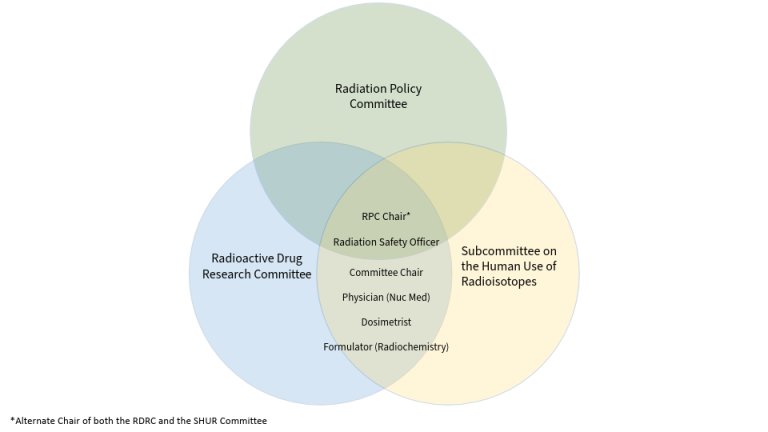
The Radioactive Drug Research Committee (RDRC) and the Subcommittee on the Human Use of Radioisotopes (SHUR) are subcommittees under the U-M Radiation Policy Committee (RPC) and are Ancillary Committees to the Institutional Review Board (IRBMED). These subcommittees review uses of radioactive material in/on humans, including radiopharmaceuticals administered to human subjects for the purpose of research. RDRC or SHUR approval is required for IRBMED approval.
RDRC & SHUR Committees
The RDRC and SHUR are joint but distinct committees. While the same members serve on both committees, their respective functions, regulatory requirements, and review criteria are distinct:
RDRC
The RDRC reviews the use of radiopharmaceuticals in humans for the purpose of basic science research, not intended for therapeutic or diagnostic purposes.
The research must not propose to determine the safety or effectiveness of the radiopharmaceutical.
Protocols approved by the RDRC are not clinical trials.
Research conducted through the RDRC approval pathway does not require an Investigational New Drug application (IND) but the RDRC pathway introduces significant restrictions for research design.
To understand these limitations, see 21 CFR 361.1 and the FDA guidance document “The Radioactive Drug Research Committee: Human Research Without an Investigational New Drug Application” (including the Q&A pages).
SHUR
The SHUR reviews clinical uses of radioactive material, including research studies that don’t fall under RDRC purview. SHUR review applies when the radiopharmaceutical is FDA-approved or is being administered under an existing IND.