Grab a page corner and drag to turn it, or use the Previous and Next buttons, the arrow keys, or the links on the cover page.

Research Safety Emergency Procedures
Emergency
- Call: 911
- Use: U-M Division of Public Safety & Security (DPSS) Smartphone App
Non-Emergency
- Call DPSS: (734) 763-1131 or text 377911
- Call Environment, Health & Safety (EHS): (734) 647-1143
Lab member emergency preparation:
- Register with the University of Michigan Emergency Alert System via Wolverine Access.
- Ensure the DPSS Emergency Procedures poster is posted in a visible location.
- Become familiar with the quickest exit routes from your building. Know TWO ways to escape.
- Know the location of exit routes from the building and be aware of the location of safety equipment (eyewash station, emergency shower, spill kit, fire blanket, fire extinguisher, etc.).
- Know how to provide your location to a responder (building name, room number, cross streets, etc.).
- Keep emergency supplies in your office or lab (First Aid Box & Stop The Bleed Kit, flashlights, comfortable shoes, bottled water, batteries, and portable radios).
- Locate the nearest fire extinguisher and pull station and schedule a fire extinguisher training course with EHS
Emergency Evacuation and Power Outages
Keep a flashlight and batteries in key locations throughout your work areas.
In the event of an emergency evacuation or major, campus-wide outage, the University of Michigan has emergency generators that will restore power to some areas of campus. You can track the progress of the outage here: Facilities and Operations – Utilities
In Case of Emergency Evacuation or a Major, Campus-Wide Power Outage:
Prior to leaving the lab, and only if it is safe to do so, secure the laboratory.
- Remain calm.
- Follow directions from DPSS for immediate action.
- Do not use candles, lighters, or other types of open flames for illumination purposes.
- Turn off the light switches.
- Report utility outages to the building’s facility contact or to the Facilities Service Center (FSC) at (734) 647-2059.
Laboratory personnel:
- Prior to leaving the lab, and only if it is safe to do so, secure all experiments and the laboratory:
- Unplug non-essential electrical equipment (including computers, ovens, and hot plates).
- Shut off compressed gases prior to evacuating.
- If possible, return all chemicals to their original storage location.
- Stop all reactions, chemical processes, and other similar activities.
- Fully close all fume hoods and biological safety cabinets.
- Cover and seal all chemical/biological/radioactive materials, as well as hazardous waste containers.
- Securely close all refrigerators and freezers.
- Shut off compressed gases and water.
- Vacate and inform emergency responders of any processes, experiments, or equipment still in operation that may pose a threat to health, property, or the environment.
Fire
You must call 911 to report all fires!
Reporting Fire Events
All fires and unintentional ignition events, even those that do not activate alarms or require emergency services, must be reported immediately to the University of Michigan Division of Public Safety and Security (DPSS) by calling 911. EHS will investigate and prepare a report needed for U-M Risk Management to support insurance claims for damages.
In Case of a Fire
- Review the locations of fire alarm pull stations, fire extinguishers, egress stairways, and emergency exits in your building(s).
- Activate the fire alarm system if you see smoke or a fire.
- Evacuate the building immediately using the nearest marked exit.
- Use stairs. Do not use elevators.
- Encourage those around you to evacuate as well.
- Assist those with disabilities or those who cannot safely evacuate the building by getting them to a safe rescue location and notifying emergency responders of their location as soon as possible.
- Keep building exits and fire lanes clear.
- Meet at designated assembly areas.
- Re-enter only when directed by authorities.
- Follow directions of DPSS and the Building Incident Response Team (BIRT).
Fire Extinguisher Discharge
In the event a fire extinguisher is discharged, you must contact the Environment, Health & Safety (EHS) Fire Safety Service at (734) 647-1143. EHS must be notified because, depending on the building, notification must be made to the State of Michigan Bureau of Fire Services. After using a fire extinguisher, it must be replaced with a fully charged fire extinguisher. To replace the discharged extinguishers, contact the Facility Service Center (FSC) at (734) 647-2059.
Injury Response and Reporting
If emergency response is needed: Call 911
The Importance of Reporting
Being safe at the University of Michigan (U-M) requires a positive safety culture, where we learn from mistakes and near-misses to improve and prevent future occurrences. It is vital that you report all incidents, including near misses, injuries resulting from your activities, non-compliance with safety and environmental rules, and general unsafe work conditions, so that we can learn and grow. Report them to EHS, and we will investigate the cause of the incident, implement corrective actions, and share the lessons learned with others.
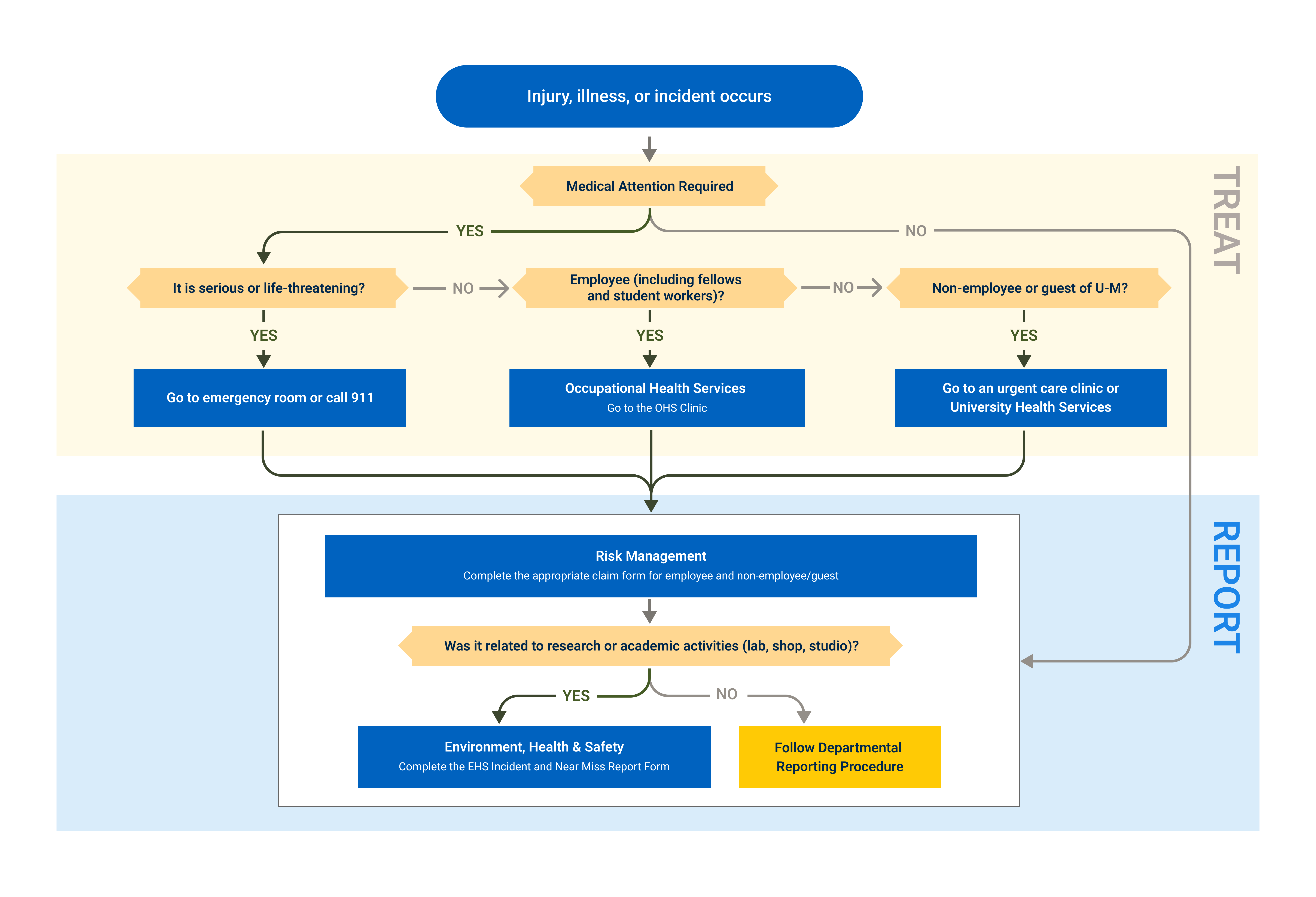
Treating and reporting emergencies
Call 911 for true emergencies requiring immediate action:
- Seek medical care for serious or life-threatening injury or illness at the U-M Emergency Room
- Report to EHS
Treating non-life-threatening incidents
Individuals experiencing a non-life-threatening issue should visit:
- U-M Occupational Health Services (Business hours): (734) 764-8021
- U-M Emergency Room (After business hours / Weekends): (734) 936-6666
Students experiencing a non-life-threatening issue should:
- Contact University Health Service: (734)764-8320
Report all work-related incidents: (near misses, fires/explosions, property damage, injuries, or illnesses)
Step 1:
Report all incidents related to research and academic fields (Laboratories, Shops/Studios) to EHS using the Incident and Near Miss Report Form.
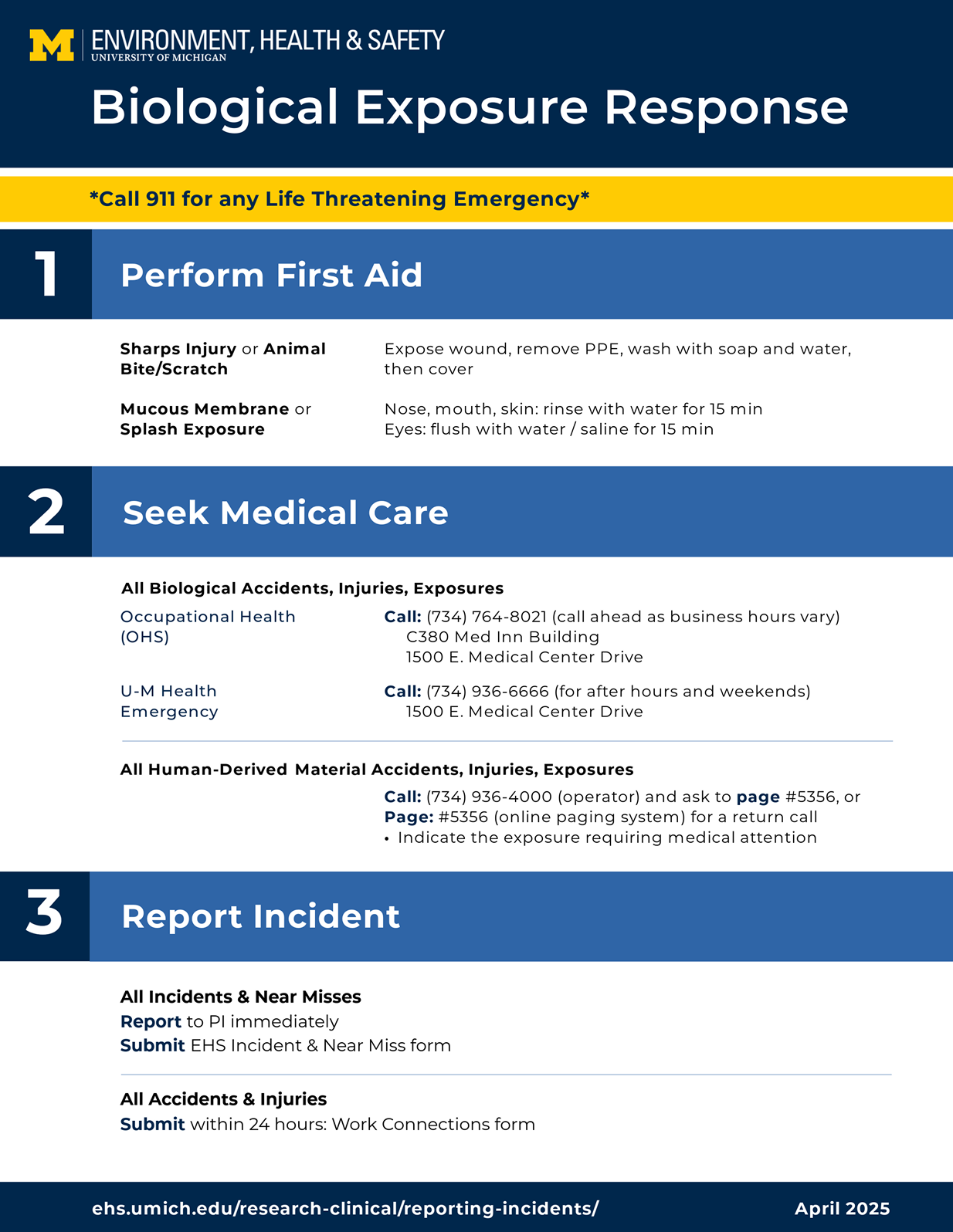
- Biological Exposures: Read the “Biological Exposure” section.
- Radioactive Material Incidents: Read the “Radiation” section.
Step 2:
Additionally, report all incidents that result in injury or illness:
- Employees: Work Connections using the Illness or Injury Report Form
- Non-Employees and Guests: Injury Report for Non-Employees.
Incident Reporting Flowchart
Resources
Occupational
Health Services
University
Health Counseling
MI
Safety Portal (MISP)
EHS:
Incident and Near Miss Report form
Work
Connections: Claim Submission form
Non-Compliance
Use one of the following methods to report an issue:
-
Call EHS at
(734) 647-1143.
- EHS will protect the identity of the caller, if requested, during the investigation and subsequent resolution of the issue.
- In many instances, safety and environmental issues need to be addressed immediately to prevent injury or further damage; we recommend using this method to receive immediate attention from EHS staff.
-
Contact the
U-M
Compliance Hotline
to report an issue.
- The Compliance Hotline uses a third party to handle calls, allowing the caller to remain anonymous.
- However, you should be aware as the issue works its way through the system, it may be a matter of days before it reaches EHS staff for investigation. If your situation involves an imminent hazard, we highly recommend a direct call to EHS for assistance.
Biological Spill
Immediately report spills and accidents to the Principal Investigator (PI) and via the Incident and Near Miss Report Form. You must note spills involving recombinant nucleic acids on the form. A minor spill is one that the laboratory staff is capable of cleaning up safely without the assistance of EHS and/or emergency personnel. A major biohazardous material spill requires active assistance from EHS or emergency personnel. Contact EHS at [email protected].
Response Procedure for a Minor Spill of Biohazardous Materials Outside a Biosafety Cabinet
- If someone is exposed, refer to Biological Exposure Response Guide.
- Alert people in the immediate area of the spill, post a warning sign if necessary, and inform your supervisor (PI).
- Review cleanup procedures and assemble decontamination materials, including an appropriate disinfectant for the agent(s) in use.
- Wear appropriate Personal Protective Equipment (PPE): at minimum lab coats, gloves, and safety glasses. Consider additional PPE based on hazards and site-specific procedures.
- Remove sharp objects using mechanical means (e.g., forceps, tongs, a broom and a dustpan) and place into a sharps container.
- Cover spill with paper towels or other absorbent materials.
- After the paper towel is in place, pour disinfectant to circle and saturate the spill area, starting from the edges and working inward.
- Allow appropriate contact time to disinfect according to manufacturer’s instructions.
- Transfer all contaminated materials (paper towels, labware, PPE, etc.) into biohazard waste containers for disposal.
- As needed, repeat steps to cover and saturate the spill area with disinfectant to allow for sufficient decontamination.
- Place all remaining contaminated materials, including PPE, into biohazard waste containers for disposal. If applicable, disinfect non-disposable items (e.g., eye protection, forceps).
- Wash hands with soap and water.
Response Procedure for a Minor Spill of Biohazardous Materials Inside a Biosafety Cabinet
- Leave the cabinet turned on.
- Don double gloves, a lab coat, and eye protection.
- Carefully cover spilled material with a paper towel.
- After the paper towel is in place, wet with an appropriate disinfectant.
- Let stand 15-20 minutes.
- Wipe up and wash surface with appropriate disinfectant.
- Spray or wipe cabinet walls, other work surfaces, and equipment with the appropriate disinfectant.
- If necessary, flood the work surface, drain pan, and catch basin below the work surface with disinfectant. Allow at least 15-20 minutes of contact time.
- Soak up the disinfectant and drain the catch basin into a container.
- Lift the front exhaust grille and tray and wipe all surfaces. Ensure that no foreign materials are blown into the area below the grille.
- If a 10% bleach solution is used on metal surfaces, rinse with water or 70% ethanol after decontamination is complete.
- If the spill overflows into the interior of the cabinet, more extensive decontamination of the cabinet may be necessary. Contact EHS (734) 647-1143 for decontamination of the cabinet.
Chemical Spill
Resources
In the event of a spill, consult the following documents for information about spills and emergency response:
- Chemical’s Safety Data Sheet (SDS)
- Process-specific Standard Operating Procedures (SOP)
Notes and Precautions
The range and quantity of hazardous substances used in laboratories requires pre-planning to respond safely to chemical spills. Cleanup of a chemical spill must be done by appropriately trained personnel.
Spill kits with instructions, absorbents, reactants, and protective equipment should be available to clean up minor spills. A minor chemical spill is one that the laboratory staff is capable of handling safely without the assistance of safety and emergency personnel. A major chemical spill requires active assistance from emergency personnel.
Minor Chemical Spill Response Procedure
- Alert people in the immediate area of the spill. Isolate the area and keep other personnel out of the contaminated area.
- Wear protective equipment, including safety goggles, gloves, and long-sleeve lab coats.
- Avoid breathing vapors from spills.
- Confine spill to as small an area as possible.
- Do not wash the spill down the drain.
- Use appropriate kit to neutralize and absorb inorganic acids and bases. Collect residue, place it in a container, and dispose of it as chemical waste.
- For other chemicals, use appropriate kit or absorb spill with vermiculite, dry sand, or diatomaceous earth. Collect residue, place it in a container, and dispose of it as chemical waste.
- Clean spill area with water.
Major Chemical Spill Response Procedure
- Attend to injured or contaminated persons and remove them from exposure.
- Alert people in the immediate area to evacuate.
- If spilled material is flammable, turn off ignition and heat sources. Don’t light Bunsen burners or turn on other switches.
- Contact DPSS at 911 as soon as possible for assistance. This will initiate EHS emergency responders.
- Close doors to the affected area.
- Post warnings to keep people from entering the area.
- Have a person available that has knowledge of the spill incident to assist emergency personnel.
Report all spills through MI Safety Portal to document the incident.
Be Prepared for Spills
- Keep updated emergency response procedures for your area.
- Post a list of contacts in case of a spill.
- Post an evacuation route.
- List the location of spill response materials.
- Train employees how to properly use spill response materials in advance.
- Assign a person to test cleanup equipment periodically and maintain its inventory.
Radioactive Spill
Notes and Precautions
Emergencies will typically be in the form of spills, fires, or explosions. As a result, radioactive materials may be spread around a facility. Radioactive contamination can be spread beyond the immediate spill area by the movement of personnel involved in the actual spill or cleanup effort. Prevent the spread of contamination by confining the movement of personnel until a qualified person has monitored them and found them to be free of radioactive contamination.
Radioactive Spill Response Procedure
- Don’t panic! Get control of the situation.
- Attend to injuries or emergencies first. Injuries take precedence over radioactive contamination.
- Warn others and request radiological assistance from others.
- Do not allow others into the contaminated area.
- Direct potentially contaminated personnel to stay in the affected area of the laboratory until they have been monitored and shown to be free of contamination.
- Isolate and contain the spill to a localized area of the laboratory. Post or tape off the affected area and establish an entry “control point” into the area.
- Do not spread contamination beyond the immediate area. Leave contaminated shoes in the affected area.
- Monitor yourself and the affected area to identify the extent of the contamination. Use smears/swipes or an appropriate radiation survey meter. Reminder: Radiation survey meters cannot detect tritium (³H)!
- EHS Radiation Safety Service at (734) 647-1143 (Business hours), DPSS at (734) 763-1131, or call 911 (After hours) as soon as possible for assistance.
- Provide: building name, room number, radionuclide involved, brief description of radiological incident, contact person’s name, and phone number at the spill site.
- Note the time and estimated meter measurements for identified skin contamination. Then, initiate decontamination of contaminated skin (soap and warm water).
- Wear appropriate protective clothing: long-sleeved lab coat, disposable gloves, shoe covers or booties, and safety goggles.
- Cover wet spills with paper towels or absorbent pads. Discard contaminated absorbent materials into a solid radioactive waste drum or plastic bag.
- Cover dry spills with slightly dampened paper towels or absorbent pads.
- Assist EHS Radiation Safety Service personnel with decontamination or smear/swipe counting.
All spills should be reported through MI Safety Portal afterwards to document the incident.
*Note: Spills involving radioactive materials must be reported to the Radiation Safety Service Team (734) 647-1143 within 24 hours of the incident.
EHS Contacts
Environment, Health & Safety
University of Michigan
1239 Kipke Drive
Ann Arbor, MI 48109-1010
Phone: (734) 647-1143
Email: [email protected]
Office Hours: 7:00 am – 4:00 pm
After-hours emergency contact through U-M Police Department at (734) 763-1131 or dial 911.
Specific Topic Contacts
Animal Research Safety: [email protected]
Biosafety: [email protected]
Chemical Inventory: [email protected]
Construction Safety: [email protected]
Dosimetry: [email protected]
Ergonomics: [email protected]
Fire Safety: [email protected]
Hazardous Waste: [email protected]
Lab Safety: [email protected]
Laser Safety: [email protected]
Medical Surveillance: [email protected]
MISP: [email protected]
Radiation Safety: [email protected]
Respirator: [email protected]
Training: [email protected]
Ventilation: [email protected]